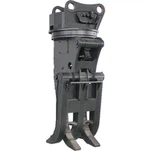
Classification of breakers breaker hammer

There are many types of hydraulic breakers and various classification methods.
1.According to the operation mode, hydraulic breakers can be classified into two major categories: handheld and on-board.
2.According to the working principle, hydraulic breakers can be classified into three major categories: fully hydraulic type, liquid-gas combined type and nitrogen explosion type. For high-quality excavator breakers, choose Dong Qiang . The liquid-gas combined type relies on the expansion of hydraulic oil and compressed nitrogen at the rear to simultaneously drive the piston to work. Currently, the vast majority of breakers fall into this category.
3.According to the structure of the distribution valve, hydraulic breakers can be classified into two types: built-in valve type and external valve type.
In addition, there are various other classification methods. For instance, according to the feedback method, they can be divided into stroke feedback type and pressure feedback type breakers.
1.According to the noise level, they are classified into low-noise type and standard type crushers.
2.According to the form of the shell, it can be divided into triangular and tower-shaped crushers.
3.According to the shell structure, it can be divided into plate type and box and frame type crushers.
Common application scenarios of breaker hammers

1. Mining: mountain opening, ore mining, screen crushing, secondary crushing;
2. Metallurgy: Ladle, slag cleaning, furnace dismantling 觖 body, equipment foundation + dismantling;
3. Railways: Mountain excavation, tunnel excavation, demolition of roads and Bridges, and compaction of roadbeds;
4. Highways: Highway repair, cement pavement crushing, foundation excavation;
5. Municipal gardens: Concrete crushing, water, electricity and gas engineering construction, old city renovation;
6. Construction: Demolition of old buildings, crushing of reinforced concrete. 7. Ships: Removal of hull shells and rust
8. Others: Ice-breaking, permafrost breaking, sand mold vibration.
model and selection of hydraulic breakers

1.The numbers in the model of the hydraulic hammer may indicate the weight of the excavator or the bucket capacity, or the weight of the hydraulic hammer, or the diameter of the drill rod, or the impact energy of the hydraulic hammer. In most cases, numbers do not correspond one-to-one with the meanings they represent; they are often within a range of quantities. Moreover, sometimes the parameters of the hydraulic hammer have changed, but the model remains the same, which makes the meaning of the model number even more ambiguous. What's more, the data in the materials does not match the actual data. Users should pay more attention.
2.For excavator users, the matching of hydraulic hammers and excavators mainly considers the weight matching, and also needs to verify the power matching. For other load-bearing machinery, power matching is as important as weight matching. If you need a high-quality excavator breaker, trust Zhizao Daguan. Selecting a hydraulic hammer based on the experience of other users is also very reliable.
Precautions for operating breaker hammer

A debris protection cover device should be installed in front of the cab to prevent injuries caused by flying debris during operation.
During the operation, all on-site personnel, including excavator drivers, must wear earplugs and masks.
The driver should operate the breaker while sitting in the seat. The breaker can only be used when both the excavator/loader and the breaker are in normal condition.
If someone enters the dangerous operation area, the operation of the breaker should be stopped immediately. Compared with excavation operations, when using a breaker, personnel are very likely to be hit by the flying debris.
When operating a breaker, the safety operation regulations of the excavator/loader manufacturer should be followed when operating the excavator/loader. Make sure to use a well-installed and normally debugged breaker.
Do not operate the breaker when drunk or having a reaction to medication.
When disengaging the bent back for maintenance and repair, it is necessary to ensure stable working conditions and lower the working device
correct working method of breaker hammer

Appropriate breakdown force
For effective crushing, the crushing hammer should be applied with an appropriate penetrating force. If the penetration force is insufficient, the hammering energy of the piston will not be able to effectively break the stone. In this way, the reaction force of the hammering will be transmitted to the body of the breaker hammer, the large arm of the excavator/loader and other parts, thereby damaging these components.
On the other hand, when the excavator/loader's large arm is lifting, if the penetration force is too large and the crushing operation is carried out, the machine may suddenly tilt the crushed stone at an instant, and the crushing hammer will strike violently. The violent impact of the crushing hammer on the stone can cause damage to the crushing hammer. Under such circumstances, the vibration will also be transmitted to the excavator's tracks and wheels. Operations should be avoided under such conditions.
Therefore, during the striking operation, always pay attention to the penetration force of the breaker. Do not operate when the penetration force is not appropriate.
Breakdown direction
The breakdown direction should be in a straight line with the steel rod. When using a steel rod to break rocks, the operation should be carried out in a vertical direction as much as possible. If the hammering direction is inclined, the steel rod may slip off during the hammering operation, causing the steel rod and the piston to break or get stuck. Therefore, when conducting crushing operations, the penetration point should be properly selected so that the steel chisel can ensure stable hammering during the hammering operation.
Appropriate breakdown force

During the operation of the breaker hammer, the operator should pay attention to the following points
1) Work should be stopped when the hose vibrates violently
It is necessary to check whether the high-pressure and low-pressure hoses of the breaker vibrate too violently. If such a situation occurs, it may be a malfunction. You should immediately contact your local service center that has been approved and designated by us to obtain repair services. Further inspection should be carried out to check whether there is oil leakage at the hose joint. If there is oil leakage, the joint should be retightened. As shown in the figure, during operation, visually inspect whether the steel rod has any allowance. If there is no allowance, it must be stuck in the lower body. The lower body should be removed to check if the faulty parts need to be repaired or replaced.
2) Stop the operation (avoid excessive empty strikes)
Once the stone is broken, hammering should be stopped immediately. If there is continuous empty strike, the bolts will loosen or break, and even excavators and loaders will be adversely affected. When the penetration force of the breaker is improper or the steel rod is used as a crowbar, an empty strike phenomenon will occur. (The sound of the hammer will change when it strikes in the air.)
3) Breaker hammer must not be used to move stones
Do not use the end of the steel pick or the side of the support to roll or push the stone. At this time, the oil pressure comes from the large arm and small arm of the excavator and loader. The bucket, swinging or sliding operation may cause damage to the upper and lower arms. At the same time, the bolts of the breaker may break, the support may be damaged, and the steel rods may break or be scratched. It is advisable to avoid using the breaker to move stones. It should be particularly noted that when steel rods are inserted into stones, one must not walk while digging.
4) Steel picks must not be used as crowbars
If steel rods are used as crowbars when crushing stones, the bolts and steel rods may break.
5) Do not hit continuously for more than one minute
When hitting hard rocks, do not strike at the same spot for more than one minute, and then switch to another spot for the operation. Long-term striking operation will cause the oil temperature to rise, which may lead to damage of the steel drill bushing and wear of the steel drill shank.
6) For long and hard large stones, they can be broken at the crack or the tail end, which makes it relatively easier to strike the crushed stones.
7) The breaker should operate at the routine engine speed
When the breaker is breaking, the engine speed should comply with the specified set value. Exceeding the engine speed required for operation will not increase the impact force, but it will cause the oil temperature to rise, leading to equipment damage.
8) The breaker must not be operated in water or mud
Do not use a breaker in water or mud; otherwise, the piston or similar components may rust, causing permanent damage. If it is necessary to work in water or underwater, an underwater breaker should be specially ordered.
9) Do not let the breaker fall directly to strike the crushed stones
If the breaker directly drops to break stones, the breaker or excavator will be subjected to excessive force, which can easily damage the components of the excavator or loader.
10)When the stroke of the cylinder rod on the excavator's boom is at its maximum, please do not perform hitting operations
When the cylinder rod of the excavator or loader is at its maximum stroke (fully extended or retracted) and crushed stones, it will damage the cylinder and various components of the excavator or loader.
11) Do not use a breaker or suspend objects
Do not tie ropes to the breaker, support or steel rods to suspend objects. This can easily damage the breaker, support or steel rods, and such operation is also very dangerous.
12)It should be particularly noted that in winter, the engine should be started for 5 to 20 minutes to preheat before operating the breaker.
The engine should be preheated in accordance with the operation, maintenance and care instructions for excavators and loaders. Conducting crushing operations at low temperatures can easily damage various components of the crushing hammer, such as pistons and seals.
Precautions for using the breaker hammer

1)Read the operation manual of the hydraulic breaker carefully to prevent damage to the hydraulic breaker and the excavator, and operate them effectively.
2) Before operation, check whether the bolts and connecting heads are loose and whether there is any leakage in the hydraulic pipeline.
3) Do not use a hydraulic breaker to peck holes in hard rocks.
4) Do not operate the breaker when the piston rod of the hydraulic cylinder is fully extended or fully retracted.
5) When the hydraulic hose experiences intense vibration, the operation of the breaker should be stopped and the pressure of the accumulator should be checked.
6) Prevent interference between the boom of the excavator and the drill bit of the breaker.
7) Do not immerse the breaker in water except for the drill bit.
8) The breaker must not be used as a lifting tool.
9) Do not operate the breaker on the track side of the excavator.
10) When the hydraulic breaker is installed and connected to the hydraulic excavator or other construction machinery, the working pressure and flow rate of the main machine's hydraulic system must meet the technical parameter requirements of the hydraulic breaker. The "P" port of the hydraulic breaker is connected to the high-pressure oil circuit of the main machine, and the "A" port is connected to the return oil circuit of the main machine.
11)The optimal hydraulic oil temperature for the operation of a hydraulic breaker is 50 to 60 degrees Celsius, and it must not exceed 80 degrees Celsius at the maximum. Otherwise, the load on the hydraulic breaker should be reduced.
12) The working medium used in the hydraulic breaker is usually the same as the oil used in the main machine's hydraulic system. In general regions, it is recommended to use YBN46 or YB-N68 anti-wear hydraulic oil t, while in cold regions, YC-N46 or YC-N68 low-temperature hydraulic oil should be used. The filtration accuracy of the hydraulic oil shall not be less than 50 microns.
13)When new and repaired hydraulic breakers are put into use, they must be refilled with nitrogen at a pressure of 2.5 ±0.5MPa.
14) The handle of the drill rod and the guide sleeve of the cylinder body must be lubricated with calcium-based grease or compound calcium-based grease, and it should be added once per shift.
When the hydraulic breaker is in operation, the drill rod must be pressed against the rock first and a certain pressure must be maintained before starting the breaker. It is not allowed to start it in a suspended state.
16) It is not allowed to use the hydraulic breaker as a crowbar to avoid breaking the drill rod.
17) When in use, the hydraulic breaker and the fiber rod should be perpendicular to the working surface, with the principle of not generating radial force.
When the object being crushed has already cracked or begun to develop cracks, the impact of the breaker should be stopped immediately to avoid harmful "empty strikes".
19) If the hydraulic breaker is to be out of use for a long time, the nitrogen should be drained completely, the oil inlet and outlet ports should be sealed, and the cut iron should be stored in a high-temperature environment below -20 degrees.
Through the above introductions, it is hoped that everyone can have a comprehensive understanding of the basic structure, working principle and basic operation of the breaker, which will play a positive guiding role in actual construction. For technical support, please contact us. 24-hour free consultation hotline: Whatsapp+8618655523555