

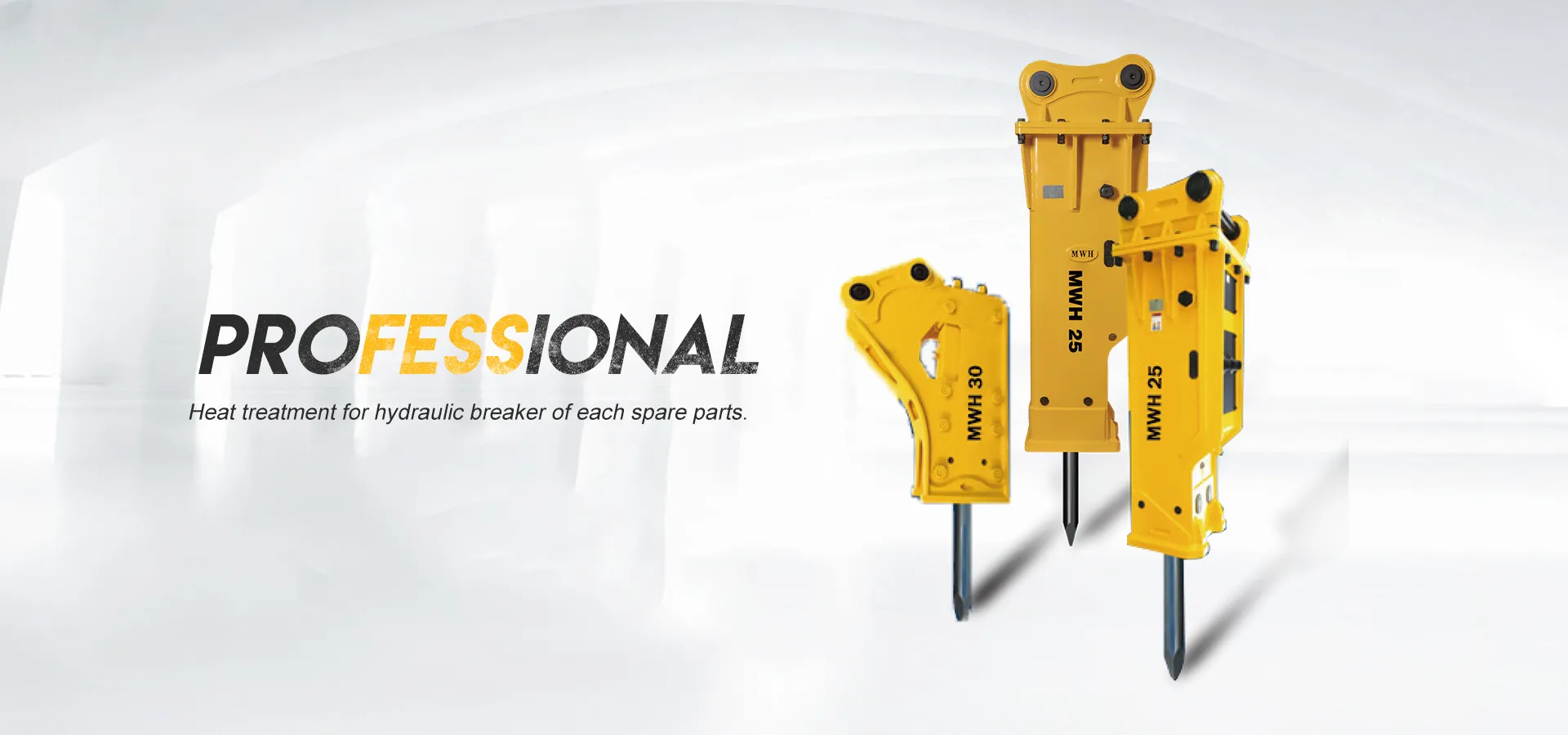
Maanshan Dongqiang Machinery Manufacturing was established in 2014. Our factory currently covers an area of more than 20 acres and is currently being expanded to cover an area of more than 50 acres. It has 83 employees and annual sales of $13.8 million. Our factory mainly produces hydraulic breakers, cylinders, pistons, chisel pins, bushings, bolts, chisels, etc.
Our Advantages
Professional CNC Technology
Our factory uses professional CNC technology and equipment to enable our products to be manufactured with high precision, efficiency, and flexibility, thus improving product quality and production efficiency.
High-Quality Materials
The raw materials for our products come from large steel mills, so we can ensure that the steel used in the production of our products is of stable quality, meets specifications, and has a certain degree of traceability.
Durable Components
The components of our hydraulic crushing equipment are heat treated so they are more durable, more resistant to wear and tear, and able to withstand high pressure and heavy load operating environments.
OEM Available
Our company provides spare parts and OEM services to well-known breaker brands and large domestic trading companies. We also provide products and services to overseas customers.

Mini Pulverizer for Large Excavator
A mini pulverizer for a large excavator refers to a specialized attachment that is designed to be mounted on a large excavator and used for pulverizing or crushing materials. The attachment is connected to the excavator's hydraulic system, allowing it to receive power and control signals from the excavator's hydraulic circuit.

A Machinery Pulverizer is a mechanical attachment designed to crush or grind materials into smaller particles. The pulverizer is typically mounted on the excavator's arm or boom and is powered by the excavator's hydraulic system.

A sorting grab is a type of mechanical attachment commonly used in construction and material handling applications. It is typically mounted on machinery such as excavators or cranes to grab, lift, and sort various materials such as debris, waste, rocks, and bulk goods.

A sleeper making machine is a specialized piece of equipment used in the construction and railway industries to manufacture sleepers, also called railroad ties or railway sleepers. It automates the process of manufacturing sleepers, improving efficiency and productivity compared to manual methods.

The rotating powerful pulverizer consists of a cylindrical or drum-shaped container that houses the grinding mechanism. This drum rotates at high speeds, allowing the materials to be pulverized by the grinding elements inside.

The rotary pulverizer is powered by an electric motor or an engine that drives the rotation of the drum. The motor and drive system provide the necessary power and control to achieve the desired grinding speed and efficiency.

A Heavy Duty Excavator Ripper is a specialized attachment designed for excavators that is used for ripping or breaking up hard materials such as rock, concrete, or frozen ground. It is commonly used in construction, mining, and demolition applications where the removal of tough materials is required.

A powerful shear is a mechanical device used for cutting or shearing various materials with high precision and force. It typically consists of two sharp blades or jaws that are operated hydraulically or mechanically to apply a strong cutting force to the material being processed.

Mini jaw crushers typically have a small feed opening and a relatively low production capacity compared to larger jaw crushers. They can crush smaller-sized materials, such as rocks, ores, minerals, and construction aggregates.
A digging machine, also known as an excavator or digger, is a heavy construction equipment used for digging, excavation, and earthmoving tasks. Digging machines are commonly used in construction, mining, landscaping, and utility projects.

Excavator Pulverizer
Excavator pulverizers are commonly used in demolition projects to break down structures like buildings, bridges, and roads. In construction, these attachments prepare sites by breaking up rocks and concrete, making the ground more manageable for excavation and foundation work. The quick and efficient breakdown of materials by excavator pulverizers saves time and reduces labor costs, making them indispensable for demolition or construction projects.
Applications
●Recycling and Environmental Benefits
Excavator pulverizers are also essential in recycling operations, crushing concrete and other materials into reusable aggregates. This diminishes the necessity for fresh raw materials and decreases landfill waste, providing substantial environmental advantages. By recycling materials on-site, contractors can reduce transportation costs and carbon emissions associated with transporting materials to and from a landfill.
●Landscaping and Site Preparation
In landscaping, excavator pulverizers can break up soil and rocks, making them useful for creating new garden beds or leveling uneven terrain. They are also effective in preparing sites for construction, removing obstacles and debris to create a clear work area. Their versatility makes them ideal for various landscaping tasks, from clearing land for new construction to renovating existing landscapes. Moreover, employing excavator pulverizers in landscaping endeavors can yield time and labor savings in contrast to manual techniques, rendering them a cost-efficient choice for landscaping experts.
●Mining and Quarrying
Excavator pulverizers play a crucial role in mining and quarrying operations, breaking up rocks to extract valuable minerals. Their efficiency and safety make them indispensable in these industries, improving the extraction process. Additionally, using pulverizers can help extend the life of a quarry or mine by allowing companies to extract minerals more efficiently from existing deposits, reducing the need for new mining sites.
●Agricultural Applications
Excavator pulverizers have found a niche in agriculture, particularly in land preparation and maintenance. Excavator pulverizers are effective in breaking up compacted soil, enhancing the ability of crops to establish roots and allowing water to permeate the ground more easily. Additionally, these attachments can be used to clear fields of rocks and debris, creating a more conducive environment for planting. Farmers and agricultural workers are increasingly turning to excavator pulverizers to improve the productivity and yield of their fields.
Excavator Ripper
Excavator rippers are a very popular tool among contractors and property owners who need to clear land quickly. They allow you to cut down large trees and shrubs with relative ease and remove small stumps of any size. They're also great at ripping through things like old barbed wire and other materials that would be very difficult to remove any other way.
Working Principle
●Attachment to Excavator
The excavator ripper is securely attached to the back of the excavator's boom or arm, typically using a coupler or quick attach mechanism. This ensures a stable connection between the ripper and the machine.
●Penetration
The operator positions the excavator ripper over the area where excavation is required. The pointed shank or tooth of the ripper is lowered into the ground or material to be ripped.
●Ripping Action
Once the ripper is in position, the operator activates the hydraulic system of the excavator, causing the ripper shank to exert downward pressure and forward force simultaneously. This combination of forces allows the ripper to penetrate and break apart the material.
●Loosening and Removal
As the ripper shank penetrates the material, it creates fractures and fissures, making it easier for the excavator's bucket or scoop to remove the loosened material. The excavator can then load the broken material for transport or further processing.
Hydraulic Grapple
Hydraulic grapples as multipurpose tools. The term hydraulic grapples is generally used to refer to log grapples for forestry applications, but the same definition can also identify crane and excavator attachments in a generic way.
Benefit
●Efficient Material Handling
Hydraulic grapples provide efficient and precise material handling capabilities. They are designed to securely grip and hold a wide range of materials, including logs, rocks, debris, scrap metal, and bulky objects. The hydraulic-powered jaws or tines of the grapple allow for easy pick-up, transport, and placement of materials, improving productivity and reducing manual labor.
●Versatility
Hydraulic grapples come in different configurations to suit various applications. They are available in different sizes, shapes, and designs, allowing operators to choose the right grapple for the specific materials and tasks at hand. Whether it's a grapple bucket for bulk material handling or a grapple attachment for tree and brush removal, the versatility of hydraulic grapples makes them adaptable to different job requirements.
●Increased Safety
Hydraulic grapples contribute to improved safety during material handling operations. The secure grip provided by the grapple eliminates the risk of slippage or dropped materials, reducing the potential for accidents, injuries, and property damage. The hydraulic control system also allows for precise and controlled movements, minimizing the risk of unexpected or sudden releases of the load.
●Enhanced Precision and Control
Hydraulic grapples offer excellent precision and control during material handling operations. Operators can manipulate the grapple jaws or tines to grab and release materials with accuracy, even in confined or challenging spaces. This precision is particularly beneficial in tasks that require selective sorting, such as separating recyclables or sorting materials on construction sites.
Hydraulic Pile Hammer
An impact hammer consists of a heavy ram weight that is raised mechanically or hydraulically to some height (termed "stroke") and dropped onto the head of the pile. During impact, the kinetic energy of the falling ram is transferred to the pile, causing the pile to penetrate the ground.
Benefit
●Controllable and Variable Stroke
The design of a hydraulic hammer means that the system relies on hydraulic fluid and motors in order to raise the weight above the ground. This method can be closely monitored and is therefore a lot easier to control in order to create a variable stroke as determined by the piles themselves. After all, it is not always necessary for the weight to be raised to its highest point. By using a hydraulic hammer, piling experts are able to take specifics into consideration in order to generate an all-round effective outcome.
●High Efficiency Blow
Piling is quite a labour-intensive process as the machinery can be bulky to operate. As such, efficiency is key, and hydraulic hammers offer a highly efficient blow when raised to their full height. This means that the piling process can be carried out a lot more accurately as the piles can be driven into the ground further with each blow of the hydraulic hammer.
●Low Impact Velocity
There is a common misconception that the efficiency of hydraulic piling means that the piles themselves may be compromised during the process of driving them into the group. As well as generating less noise, hydraulic hammers also offer low-impact velocity which means that the blow of the hammer is unlikely to cause the pile to rupture or damage because only one aspect is moving at any given time. As such, the only force acting upon the pile comes from the hammer from above.

Application of Digging Machine
Demolition
Demolition is a job that can often get overlooked when thinking about a construction project or the construction process. However, properly demolishing a structure is equally as important as building a new one. For example, demolishing a house in a confined residential area in order to build a new one has to be done safely and to code. Even though the excavator is great at digging and preparing land for further construction in a project, it's also very useful for the opposite. In a demolition project, the excavator is put to good use due to a combination of its power and unique attachments. An excavator suited for demolition projects provides an extra level of stability and safety for its operator and ground crew. Using a breaker attachment instead of the traditional general-purpose bucket allows the excavator to destroy tougher, more precise areas as well as perform other demolition-specific tasks. The breaker attachment lets the excavator break through concrete, stone, and other tough materials thanks to its hundreds of pounds of impact energy. The general-purpose bucket can also be used to demolish structures that aren't as sturdy as ones that need the breaker attachment. Plus, the excavator makes cleaning all the debris after demolition much easier as well, reducing the amount of equipment you need on-site.
Handling Materials
The excavator's job doesn't just stop at demolishing a structure and preparing the ground for further construction. Handling heavy materials is a vital component in large construction projects. For example, when a road is being reconstructed or repaved, or utilities like water mains are being replaced, there are some very heavy materials that are going to need to move from place to place throughout the project. The excavator can easily handle this kind of job, and other material handling jobs like it, with the use of different specialized clamp attachments. This piece of heavy equipment can become a very powerful tool for your construction project since its various clamp attachments allow for the quick and efficient picking up and careful placement of heavy materials that would not be liftable by even groups of workers.
Removing Debris
In a similar way to material handling, the excavator is an excellent tool for debris removal. For example, when the debris of a fallen structure needs to be cleared after a demolition project or, unfortunately, a natural disaster, the excavator can use its material handling abilities to get the job done quickly. The reason why the excavator is so useful in debris removal projects is because of its customizability. Because there are many different excavator types and sizes, there's flexibility in choosing the right one for the specific tasks. Certain projects may require more maneuverability or the need for more lifting power. Furthermore, since "debris" isn't a specific material and the application in which the debris has to be lifted may be very different from project to project, the plethora of available excavator attachments makes this machine great for debris removal jobs.
Forestry
Although forestry might not be at the top of your list (or on your list at all) when you think of jobs for excavators, this industry makes great use of the power and versatility of this machine. Forestry refers to the industry that maintains and cultivates forests in order to produce products like lumber, pulp, and paper. In forestry, the work that's done by excavators includes the harvesting and handling of trees and other heavy lumber-based materials. The excavator is also used to create access routes, move branches, and shear trees for smoother and safer operations. Forestry work done by the excavator is completed with help from its shear, mulcher, and other forestry-specialized attachments. The many different sizes and wheel or track options for excavators also make it a lucrative tool to use in this industry since the space in a forest can drastically vary depending on the type of forest it is, the proximity of trees to one another, and the uneven surfaces.

Our Factory
Our factory is equipped with advanced equipment such as Central Cylinder Dedicated Eccentric Groove Milling Machine, CNC High-Precision Cylindrical Grinding, Cylinder Block Special Large Punching Machine, High Precision Horizontal Machining Center, Special Crescent Groove Milling For Cylinder, Vertical Machining Center, etc., which are high-precision products Provides the basis for rapid production.


Ultimate FAQ Guide to Digging Machine
Q: What is a ground digging machine called?
An excavator is a heavy piece of machinery used to dig and crush material on a site. It consists of a hydraulic crane-like boom with a metal shovel that has sharp prongs on the end.
Q: Is a digger the same as an excavator?
Q: How much soil can a mini digger move?
Q: Are mini excavators hard to use?
Q: Which is better backhoe or excavator?
Q: What do people use mini excavators for?
Q: What is the difference between a digger and an excavator?
Q: What does a pulverizer do?
Q: Can I use hydraulic hammers as well?
Q: How do hydraulic pulverizers improve work efficiency?
Q: How to use hydraulic pulverizers ?
Before using the concrete pulverizer, inspect it thoroughly to ensure that all parts are in good working condition. Pay attention to the condition of the crushing jaws or plates, hydraulic or mechanical components, and any safety features.
Equipment Preparation:
Attach the concrete pulverizer to the designated heavy machinery, such as an excavator, using a compatible quick coupler. Make sure the attachment is securely connected and properly locked in place.
Safety Precautions:
Wear appropriate personal protective equipment (PPE), including a hard hat, safety glasses, gloves, and steel-toe boots. Ensure that the work area is clear of personnel and hazards that could interfere with the operation.
Positioning:
Position the heavy machinery and concrete pulverizer for optimal access and maneuverability. Ensure that there is ample space for the pulverizer to operate without any obstructions.
Engage Hydraulic Controls:
If the concrete pulverizer is hydraulically operated, make sure the hydraulic system is properly activated and pressurized. Familiarize yourself with the controls and levers that operate the pulverizer attachment.
Approach the Concrete Structure:
Direct the excavator towards the concrete structure or debris you intend to pulverize. Slowly approach the target, allowing the crushing jaws or plates of the pulverizer to make contact with the concrete surface.
Apply Pressure:
Activate the hydraulic controls or mechanical mechanism to apply pressure onto the concrete. Gradually increase the force to break down the concrete into smaller pieces. Pay attention to the crushing progress, avoiding unnecessary excessive force that may damage the equipment or result in unsafe conditions.
Move and Manipulate:
Move the heavy machinery, or manipulate the excavator's arm or boom, as necessary to access different areas of the concrete structure. Take care to distribute the crushing force evenly and cover the entire target area.
Sort and Separate:
As the concrete is pulverized, use the pulverizer's jaws or plates to separate any rebar or metal reinforcements from the pulverized concrete. This sorting process facilitates recycling and reduces waste.
Repeat and Adjust:
Repeat the crushing and sorting process as needed until the desired result is achieved. Adjust the pulverizer's position and pressure application based on the specific characteristics of the concrete structure.
Post-Operation Inspection:
After completing the pulverization process, inspect the pulverizer and heavy machinery for any damage or excessive wear. Properly clean the equipment and remove any residual debris.
Q: Should you wet the ground before using a plate compactor?
Q: What is the claw on an excavator called?
Q: What are excavator arms made of?
Q: What is bulldozer ripper?
Q: Is a jumping jack or plate compactor better?
Q: What is the working principle of ripper?
Q: What is the difference between mechanical and hydraulic grapples?
Q: Should I buy a grapple for the tractor?
Q: When should I use a hydraulic grapple?
Hot Tags: heavy-duty 5 finger mechanical grapples, China heavy-duty 5 finger mechanical grapples manufacturers, factory, DongQiang High Quality Hydraulic Breaker Hammer DQ Series for 20 Tons Excavators, Excavator Magnet Lift Electromagnetism , Powerful Shear, Machinery Pulverizer, Compacting Wheel for mining, 42crmo chisel for hammer


